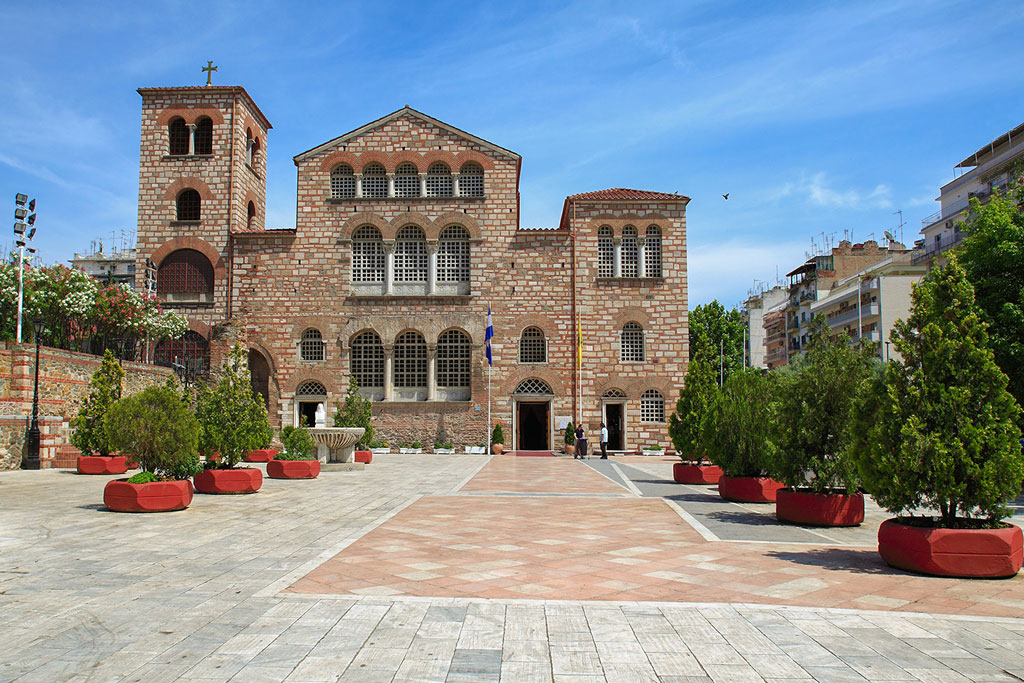
The Holy Church of Saint Demetrios, the patron saint of Thessaloniki, is located in the center of the city, on Agiou Dimitriou Street, above the ancient Agora. It is indisputably the most important Early Christian monument of Thessaloniki, both for religious and historical reasons.
The Early Christian basilica was built on the site where, during the Roman period, there was a complex of public baths. According to tradition, in these baths Saint Demetrios was imprisoned and martyred by spear, having been considered by the Roman authorities responsible for the defeat of the gladiator Lyaeus by Demetrios’ disciple, Nestor.
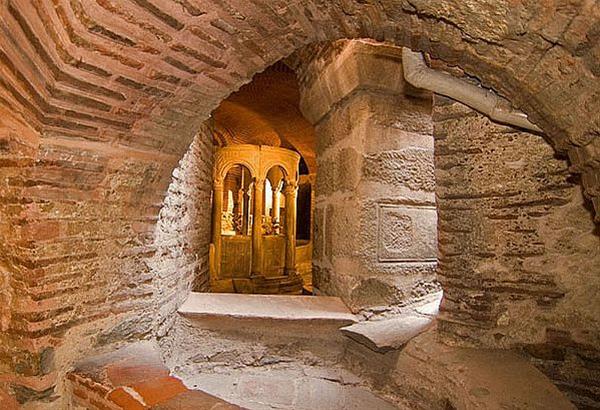
After the Edict of Milan on religious tolerance in 313 AD, a small shrine (“oikos”) was erected above the saint’s tomb. Soon, the faithful from all parts of the empire flocked to pray at his grave and to be healed of serious illnesses. Among the pilgrims was Leontios, governor of Illyricum, who, after being healed and in gratitude to Saint Demetrios, built on the site of the shrine a large three-aisled basilica, which was destroyed by fire between 626–634. The crypt became the core of the centuries-old veneration of the saint, where, according to tradition, his miraculous “myron” (holy oil) flowed into small cisterns and was distributed to the faithful in clay vessels.
Here, the saint’s tomb was transferred from the baths and placed in a ciborium in the central aisle. His relics, however, were taken by the Normans during the sack of the city in 1185 and ended up in the monastery of San Lorenzo in Campo, northern Italy. In 1978, his skull and part of his relics were returned and placed in the western aisle, inside a silver reliquary beneath a replica of the old ciborium, crafted by the sculpting house of Filippotis from Tinos.
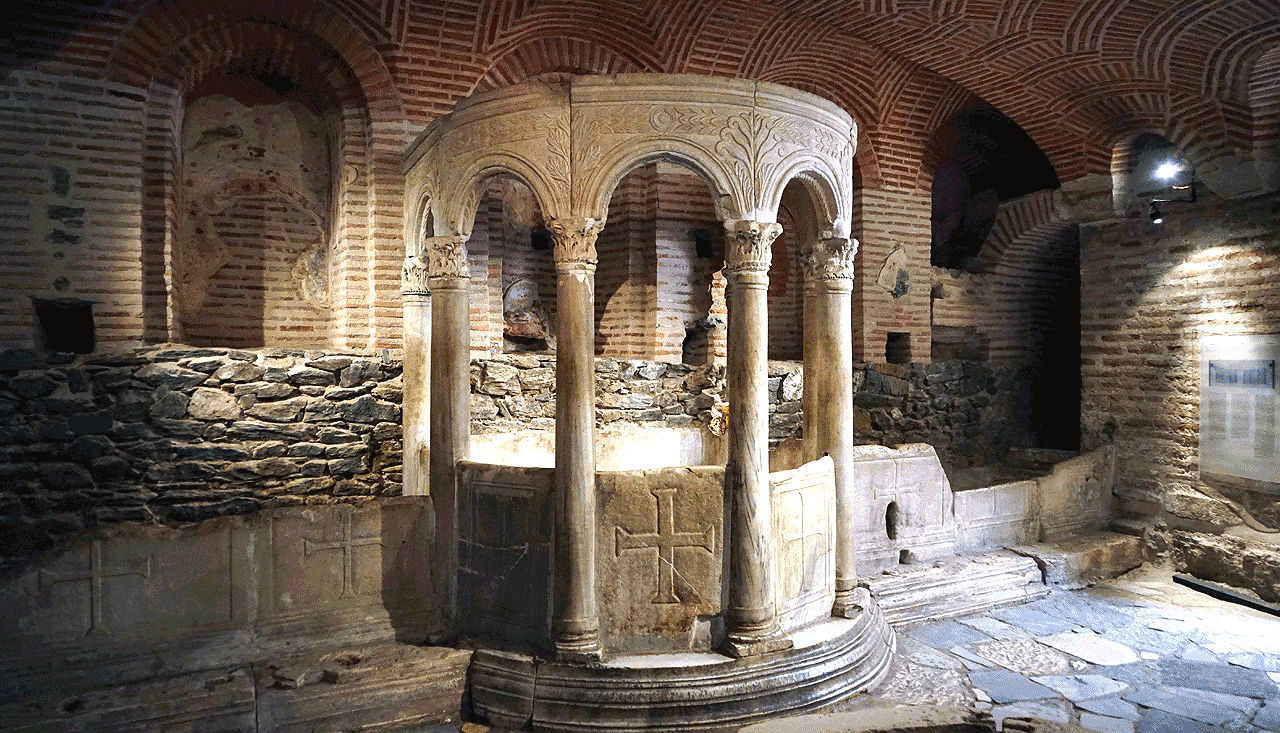
In the crypt beneath the sanctuary, the remains of the Roman baths are preserved, where, according to tradition, Saint Demetrios was martyred. Access to the crypt is via a staircase from the eastern part of the south aisle. The small shrine with its perforated apse was built on the site of the martyrdom. The holiest part of the crypt, however, is the semicircular font with marble columns, directly beneath the sanctuary, from which the miraculous myron once flowed, collected by pilgrims in small flasks until the Ottoman period, when the church was converted into a mosque. Today, the crypt houses a museum exhibition with sculptural fragments from the decoration of the church throughout its history, including parts of the marble ciborium that once encased the saint’s reliquary, 6th–7th century marble screens, drawings, and numerous photographs of the monument.
Architecturally, the church of Saint Demetrios is a five-aisled basilica with a transept and galleries (gyneceum). For its construction, various types of capitals from the 5th and 6th centuries were used, many of which today are modern copies, as is the present iconostasis.
The monument is especially renowned for its nine votive mosaic panels, located on the piers of the sanctuary and on the west wall, dating from the 6th and 7th centuries. Frescoes from different periods survive on the piers and the south wall, while the frescoes of the sanctuary are modern.
The church preserves many capitals from the 5th-century basilica, while fragments of the colorful wall revetments in marble (orthomarmarosis) from the same period survive in the narthex. Of the many mosaic offerings dedicated to Saint Demetrios, only a few, dating from the 5th to the 9th centuries, survived the great fire of 1917.
On the western wall are 5th-century mosaics depicting Saint Demetrios in a posture of prayer, and an angel blowing a trumpet. On the southeast pier near the sanctuary, he is depicted between a bishop and a governor. The inscription refers to the Slavic siege of Thessaloniki in the early 7th century and the city’s salvation, attributed to its patron saint. Another mosaic, on the east side of the pier, shows the saint with a deacon (7th century). On the third side of the same pier, Saint Sergios is depicted in prayer. On the northeast pier, three more mosaics survive, showing Saint Demetrios with two children, a supplicant, and the Virgin with Saint Theodore.
From the extensive fresco decoration, only two important paintings remain: on the south wall, the “historical” fresco depicting Emperor Justinian II with his entourage amidst a crowd (early 8th century), and on the first western pier, a fresco of Archbishop Gregory Palamas of Thessaloniki with Emperor John VI Kantakouzenos, who later became a monk under the name Joasaph.
At the beginning of the central nave, the tomb of Loukas Spandounis, a wealthy nobleman of Thessaloniki buried here in 1481, is preserved — during the first century of Ottoman rule and shortly before the church was converted into a mosque (1493).
The Chapel of Saint Euthymios, a small three-aisled basilica, is attached to the southeast side of the church. It preserves magnificent examples of Palaiologan painting (1303), attributed to the great painter Manuel Panselinos and his workshop, whose works are also found in the Protaton at Karyes on Mount Athos.
Throughout the Byzantine period, the church remained an important pilgrimage center, and Saint Demetrios came to be regarded as the protector of the Balkans.
In 1493, after the conquest of Thessaloniki by the Ottomans, the church was converted into a mosque (Kasimiye Camii). Christian worship was then limited to a small section in the northwest corner, where a cenotaph of the saint was established. The church was restored to Christian worship in 1912, after the liberation of the city.
However, the great fire of 1917 destroyed most of the monument, and its restoration was completed in 1949.
Opening Hours: 06:00 - 20:00
Guidelines: Entry is not permitted to visitors wearing shorts, bermuda shorts, or sleeveless clothing.
Address: Αγίου Δημητρίου 83, 54633 Θεσσαλονίκη
Contact: +30 2310 270008 , +30 2310 260915
Wbsite: www.agdimitriosthes.gr
Underneath the Church of St Demetrios is the place where St Demetrios, Thessaloniki’s patron saint, was martyred.
The crypt of Aghios Demetrios has been an archaeological site since its discovery in 1918. After 1950, some of the sculptures that survived the great fire of 1917, were transfered by S. Palakanides in the area of the fountain in an effort to remodel the whole place. In the years 1985-1988, excavations were conducted in the north part of the Crypt, and its remains were restored. An exhibition was organized, including the excavation finds as well as the antiquities that were rescued from the catastrophic fire.
A pamphlet on the exhibition has already been published, but a proper guide book to the museum is now in preparation.
The museum contains early Christian sculptures of the 5th, 6th and 7th centuries found in the church, Byzantine sculpture from the church, dated to the 11th-14th centuries, and various excavation finds (coins, pottery), dated to the 5th-14th centuries.
Hours: Winter Monday Closed, Tuesday - Thursday 08:00 - 15:00, Friday 08:00 - 13:30 & 19:00 - 22:00, Saturday - Sunday 07:30 - 14:30
Rules: No shorts or sleeveless shirts
Address: 83, Demetrios church St., 54633 Thessaloniki
Contact: +30 2310 270008 , +30 2310 260915
The holy cathedral and pilgrimage church of Hagia Sophia is located in the historic center of Thessaloniki, on the square of the same name, at the junction of Agia Sophia and Ermou streets. Dedicated to the Wisdom and Word of God, it ranks, together with the churches of Saint Demetrios and Acheiropoietos, among the most important Early Christian monuments of Greece and of all Orthodoxy.
From the 8th century until its conversion into a mosque (1523–1524), it served as the cathedral of the city and is often referred to in historical texts as the “Great Church.” During the Latin occupation (1204–1224), the church was turned into a Latin cathedral but was restored to the Orthodox in 1224, following the Byzantine recapture of Thessaloniki. About a century after the Ottoman conquest of the city (1430), the church was converted into a mosque, retaining its original name (Aya Sofya Camii). However, the mosque was destroyed in the great fire of 1890 and was restored between 1907–1909. In 1913, after the liberation of Thessaloniki from the Turks, it was returned to Christian worship, and the Divine Liturgy was once again celebrated there.
The original church was a colossal five-aisled basilica dedicated to Saint Mark, built at the end of the 4th century on top of a Roman building complex. Today, the remains of its baptistery survive on the south side of the present church. That basilica was most likely destroyed by the great earthquake of 618 and the subsequent fire, and in its place the current church was erected.
Architecturally, the present church belongs to the transitional type of the cross-in-square plan, a development of the domed basilica. In its northwest corner stands a tower, a Turkish addition.
The monument preserves remarkable mosaics in the sanctuary and the dome, dating from three different periods, which are outstanding examples of Byzantine art.
The first phase, dating from the early years of Iconoclasm (726–787), is represented by the non-figurative decoration of the semi-cylindrical apse vault (a cross within a medallion, vegetal and geometric designs), confirmed by inscriptions mentioning Empress Irene of Athens and her son Constantine VI, who co-reigned between 780–788. The name of Bishop Theophilos also appears. These inscriptions are associated with the emperors’ visit to Thessaloniki shortly before the Seventh Ecumenical Council at Nicaea in 787, which marked the end of Iconoclasm.
The second phase, from the late 9th century, includes the magnificent mosaic of the Ascension of Christ in the dome. At the center, Christ is depicted within a circular glory supported by flying angels, while below stand the apostles. Among them is the Virgin Mary, flanked by two archangels pointing to the Divine Presence in the heavenly vault.
The third phase, dating from the 11th–12th century, is represented by the mosaic of the enthroned Virgin and Child in the conch of the apse, which replaced the earlier iconoclastic cross.
Fragments of 11th-century frescoes depicting holy monks, including Saint Theodora of Thessaloniki, survive in the windows of the narthex.
The rest of the decoration of the church is Islamic and belongs to the modifications carried out during the Ottoman period.
Opening Hours: 08:00 - 12:00 και 17:00 - 19:00
Guidelines: Entry is not permitted to visitors wearing shorts, bermuda shorts, or sleeveless clothing.
Address: Αγίας Σοφίας & Ερμού, 54622 Θεσσαλονίκη
Contact: +30 2310 270253
Website: agiasofia.info
Just a few kilometers outside Thessaloniki, in the village of Souroti, lies the Holy Monastery of Saint John the Theologian, where Saint Paisios the Athonite (1924–1994) is buried. Saint Paisios is one of the most beloved and revered figures of modern Orthodoxy, known for his humility, wisdom, and spiritual guidance, which attracted countless faithful from Greece and abroad.
His tomb is located in the monastery’s cemetery and has become a pilgrimage site for thousands of visitors who come to light a candle, pray, and ask for his intercession. The monastery itself is renowned for its strict monastic order, the hospitality of the nuns, and the profound atmosphere of prayer that surrounds it.
The site is serene and deeply spiritual, while the monastery also houses chapels and a publishing house with books and writings by Saint Paisios. A visit here offers both spiritual enrichment and a glimpse into the simplicity of Orthodox monastic life.
Distance from Thessaloniki: about 30 kilometers (30–40 minutes by car).
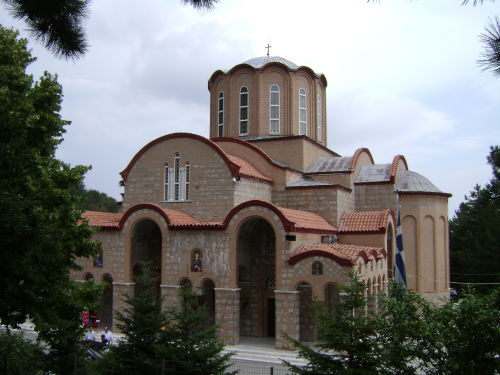
Panagia Soumela, the legendary shrine of the Pontic Greeks, is located on Mount Vermio near Veria and is one of the most significant pilgrimage sites of Hellenism. The monastery was founded in 1951 by Pontic refugees, who brought with them the sacred icon of Panagia Soumela from the historic monastery in Pontus, following the Asia Minor Catastrophe.
According to tradition, the icon was painted by the Evangelist Luke and is considered miraculous, venerated with great devotion. Every year on August 15th, thousands of pilgrims gather here to celebrate the Dormition of the Virgin Mary, in one of the largest religious festivals in Macedonia.
The monastery is built on a lush green slope, offering breathtaking views and a serene atmosphere that enhances the spiritual experience. Panagia Soumela is not only a place of prayer but also a powerful symbol of Pontic Hellenism, memory, and history.
Distance from Thessaloniki: about 80 kilometers (1 hour and 15 minutes by car).